This essay was first published to accompany Michael Carney: Transhuman Nature at praxisARTSPACE, Bowden, SA, 20 April – 19 May 2023.
What is a landscape painter without a landscape?
In Transhuman Nature, Adelaide-based artist Michael Carney presents a suite of anti en plein air landscapes. His paintings, ceramic and 3D printed forms, projections and virtual reality scenes, blow apart (then put back together) the traditions of the genre.
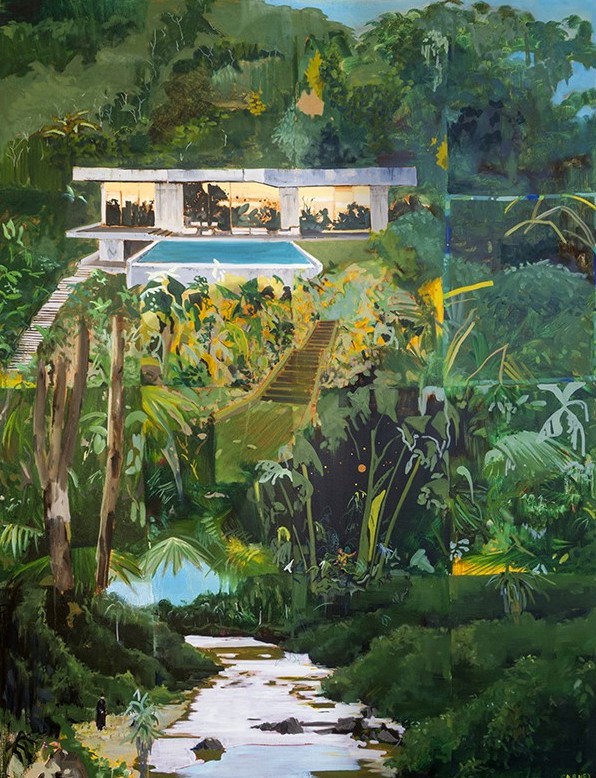
For Carney, the persona of the landscape painter feels ill-fitting, he prefers mediation. His images are fractal; the pictorial plane is glitchy and algorithmic with tropes of ‘nature’ trawled from the internet or iterated via generative artificial intelligence. Rather than grains of sand embedded in the painterly surface (evidence of the French Impressionists departure from the studio to outside) Carney’s exploration is virtual, defined by a hyperlink chain of digital navigation. Search terms such as ‘dense gothic forest’, Scandinavian trees’, ‘modernist architecture in scary movies’ unfurl as images within images, rendering scenes of collapsed horizon lines and uncanny grottos. Carney builds an impression of a place familiar yet non-specific, an anywhere.
In The Forest is a Symbol of the Unknown and the Unconscious (After Tarkovsky), Carney brings to life the anyplace. The mutable scene is a painting divided into three acts; it refers to Russian film director Andrei Tarkovsky’s 1975 film Mirror. Famous for its non-linear structure, Mirror is deeply atmospheric. In fact, it works with atmospheric effects (an impressionist’s playground too) of blazing fire, transpiring breath, rising winds, a world defined by unseen forces and physics. Tarkovsky makes use of the Kuleshov effect–whereby meaning is attributed between images cut together–to create a moving feast of dreamlike associations and phantasmagoria. It is an analogue to Carney’s digital approach. The spliced imagery of Paths or Portal, for example, offers a mercurial glimpse into some place – perhaps an equatorial island or dense European woodland. And yet, these places are resolutely nowhere. Carney’s images and forms are all atmosphere.
In the digital realm–where wind blows without movement, sunlight pools without heat–the surfaces of nature triumph. Polygons and wire mesh are wrapped and rendered; a world of pure facade is built. Arguably, the virtual world might offer us the purest distillation of landscape. As British poet and geographer Tim Creswell describes in Place: An Introduction (2015), landscape is deeply optical. Bound by capital and culture, it combines the material topography of a portion of land (that which can be seen) with the notion of vision (the way it is seen). If landscapes are to be viewed through a portal–that is, a frame, a window, the lens–then places are experiential, something to be inside of. In a world mediated, it may be more accurate to say Carney is not without a landscape but rather not within.
 BELINDA HOWDEN