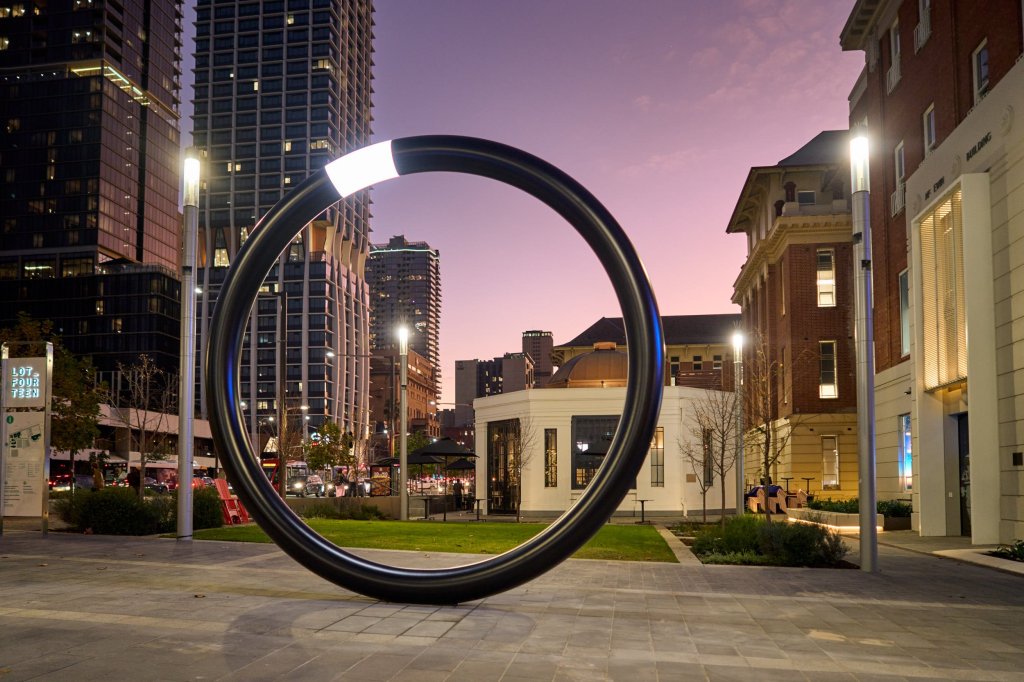
This essay was first published by Guildhouse to accompany Sundari Carmody’s public work One: all that we can see at Lot Fourteen, Adelaide, SA, in May 2022.
Before Sundari Carmody was a sculptor, she was a photographer. The Adelaide-based artist spent
much of her formal art education occupying the University of South Australia’s dark rooms, ‘drawing with light’ as the Greek etymology of ‘photography’ suggests. This formative experimentation, the purposely imperfect surfaces of her early photographic works, began Carmody’s ongoing pursuit of documenting the sensory world, that which can be felt but ultimately remains unknown. The indexical nature of photography, that is, how light constitutes the trace of a real object or moment on film, is vital to this approach. As if coming full circle, it is one Carmody describes as sculptural: ‘we look into an image but also at an image; the photograph is an object.’1
Astronomy and photography share an entangled history. While the heavens have captured
humanity’s imagination and ingenuity for millennia, it was the advent of photography in the mid-nineteenth century that propelled a revolution of new discoveries in the ‘law of the stars’. Like the telescope before it, the mechanical eye of the camera gifted us new ways of seeing. Its ability to gather light, to peer into the depths of darkness beyond the limits of human perception, brought with its innovations great illuminations: the first daguerreotype of the full moon, the first photograph of the star, Vega, and ultimately, far greater accuracy in mapping our night skies. Celestial light could now pool on film and emulsion: it could leave a trace. Photography had unwittingly revealed grand yet otherwise unseen astral objects and movements that comprise the universe around us.
Despite its title, One: all that we can see (2022) is a monument to the unknown. Carmody’s towering cosmic wheel draws on a scientific ratio decreeing the visible to invisible universe, a balance between everything seen and sensed. Upon this great wheel a small arc illuminates the sky. It captures everything observable: ‘every atom, cell, rock, planet and galaxy; everyone you have ever known; everywhere you have ever been and as far back into the history of the universe as we can see.’2 The remaining sweep of blackened steel materialises the immaterial. It describes the dense mystery of dark matter – dunkle materie as Swiss astronomer Fritz Zwicky first coined it – an omnipresent yet indeterminate force that governs our cosmological lives.
Although Zwicky proposed his dark matter hypothesis in the mid-1930s, it wasn’t until four decades later that American astrophysicist Vera Rubin solidified the aether. The detail was in the data. As the first woman to gain access to the Hale telescope at the Palomar Observatory in California, Rubin was a trailblazer in more ways than one. She pored over ‘the glass universe’ – archives of long exposure photographic glass plates of the night sky – as well as highly sensitive spectrographs developed by her colleague Kent Ford – to reveal undeniable evidence for Zwicky’s theorem.3
At the time, it was assumed the further a star from a galaxy’s gravitational centre, the slower its
movement. By mapping the motion of stars across other spiral galaxies, like our neighbour
Andromeda, Rubin proved this was not actually the case. Far from slowing down, peripheral stars
were found to move at similar speeds, sometimes even faster, than those at the centre.
Rubin’s findings implied an unseen mass, a gravitational force binding galaxies together that vastly outweighed its visible counterparts. The observable universe was suddenly inverted. Great hulking celestial objects that once dominated the plates and lenses of astronomers now appeared as mere flotsam on an immense sea of dark matter.4 It was Rubin’s contributions, in particular that informed One: all that we can see. This astrological inversion was profound, offering Carmody a ratio that proved generative.
The ratio between light and dark, what we can and can’t see, is humbling. Having it present in a public space, it becomes such a clear metaphor for anyone and anything. There are so many areas in life we can apply this same ratio – to government, the unexplored oceans, someone’s mind or consciousness. It is an intellectual prompt; we, as non-scientists, can take from it a poetry, it’s beauty and mystery.5
For Carmody, the ratio also uncovers another kind of universal law, ‘I imagine it to be self-balancing. The more you come to know, the more you discover you don’t know.’6 Although Rubin provided the first evidence for dark matter, and scientific consensus continues today, her findings never illuminated what constitutes such a force. Dark matter remains an enduring scientific mystery, an unknown quantity. Its presence is articulated not through direct observation, but in measuring the effects it has on the celestial objects and elements around it. That is, the trace it leaves on the visible cosmos. One: all that we can see shares in this metaphorical power. Despite being determinately physical (a monolithic steel orbit fronting Lot Fourteen’s North Terrace could not prove weightier in terms of its sculptural presence), it effortlessly materialises what Carmody describes as the photographic object. Light articulates light; darkness is used to plumb the depths of the unseen. Together, these elements constitute the world; they cycle one another in a perennial cosmic dance between the known and unknown.
- Sundari Carmody, interview with the author, Adelaide, 15 March 2022. ↩︎
- Sundari Carmody, email correspondence, 16 March 2022. ↩︎
- Dava Sobel, The Glass Universe: the hidden history of the women who took the
measure of the stars, Harper Collins: London, 2017. ↩︎ - Frank Close, “Vera Rubin obituary”, The Guardian, 2 Jan 2017,
https://www.theguardian.com/science/2017/jan/01/vera-rubin-obituary. ↩︎ - Carmody, interview. ↩︎
- Ibid. ↩︎
One: all that we can see was commissioned under the Lot Fourteen Arts and Culture Plan 2020, with advice from Guildhouse, the Lot Fourteen Arts and Culture Advisory Group and the Australian Space Discovery Centre.
 BELINDA HOWDEN