This profile was first published as part of Contemporary Art in the Classroom, an education resource developed by Ace Gallery and the Art Gallery of South Australia in August, 2021.
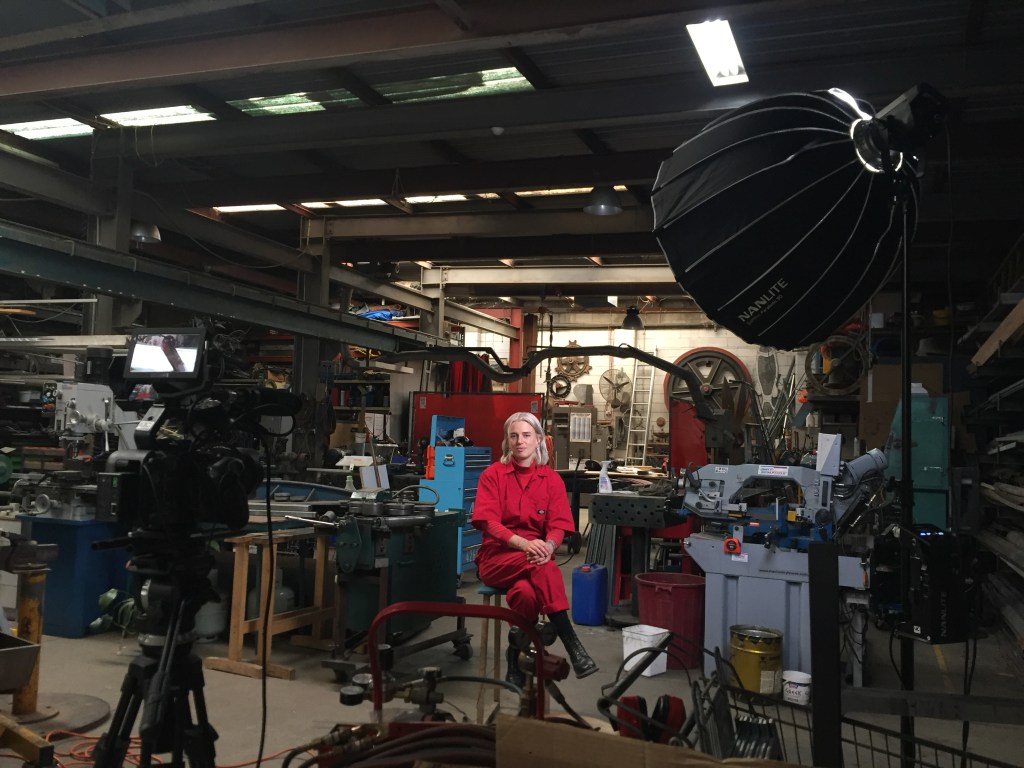
Born and raised in Adelaide, Kate Bohunnis (b.1990) is a South Australian artist known for producing pared back yet large-scale sculptural installations. Although Bohunnis trained as a printmaker, and worked predominantly in screen-printing and linocut for several years, in 2017, during her studies at Flinders University, she shifted her focus to metal fabrication. The transition from two to three dimensions marked the beginning of Bohunnis’ deep engagement with ideas of ‘productive difference’ and ‘the power of uncertainty’–metaphysical concepts developed by twentieth century French philosopher Gilles Deleuze. For Bohunnis, moving objects off the wall and into the room was a material method of working with states of uncertainty and unknowing.
“Productive difference is about purposefully disarming yourself from the things you know, the things you’re good at. It’s not about creating chaos; it is about trying to create productive change”.1
As a sculptor, Bohunnis has produced immersive installations using wax, silicone, linen, leather and latex in contradictory combinations with metal, and each other. The results are room-sized ensembles of sculptures – material gestures – charged with allusions to the body, sex, futility, violence and control. Staged in tense relation to one another, Bohunnis’ objects often take on anthropomorphic (human-like) or bodily qualities: a diagonal steel shaft impales a plump latex pillow, forcefully pinning it to the wall; a block of pink jelly wax bows mournfully in the thin grip of two tarnished metal rods; stainless steel hooks stretch a taught plane of latex like freshly flayed skin. Bohunnis undercuts the utility and functionality of her chosen materials, instead casting their given meanings and associations into a state of flux – aluminium undulates like a landscape, steel sheets are draped like textile, silicone transforms into flesh.
“The way I see materials and identity is very similar. This one thing is served to you and it appears all the same; a tube is a tube, a piece of linen is a piece of linen. But when you add or subtract from it, it creates a different conversation…it can transform into many different things”.2
In edges of excess (2020), first produced for Adelaide Contemporary Experimental’s South Australian artist survey – if the future is to be worth anything – and for which Bohunnis won the 2021 Art Gallery of South Australia’s Ramsay Art Prize, a larger-than-life stainless-steel pendulum swings interminably just millimetres above a sagging strap of flesh-coloured silicone. The sculpture draws on Bohunnis’ familial history, her mother would use the pendulum as a tool of divination. “We used it to work out where we would go in our life, to heal the body, to find centre, to find direction. That was very alluring, to have this sort of magic navigation system. But, then it became risk indulgent. We overused it”.3 Bohunnis’ part-guillotine, part-timepiece generates an uneasy and unceasing sense of precarity. A once productive device becomes disarming and dangerous, a tool for chaos rather than productive change.
In Bohunnis’ practice, the relationship between metal and the body is always present. As one of the oldest elemental skills, the discipline of metal fabrication comes with a long and gendered history associated with male labor. To work in metal, Bohunnis says “…people often comment, ‘you must be strong.’ There are specific ideas about my body – what I’m capable of, my abilities”.4 Awareness of the body extends to the spatial properties of sculpture and installation too. “I feel more of a presence standing in and around something rather than just looking at it. [Sculpture] has more of a bodily presence in the room. It can be calculated to my height and shape”.5 For Bohunnis, even metal itself holds bodily connotations, “Wood has always had a different feeling to me. It is too agricultural. Metal is industrial, it is sexy”.6
It is precisely the tensions between the surface properties of metal – industrial, mechanical, strong, cool, sleek, surgical – and its physically demanding fabrication processes – rolling, welding, pressing, casting, and polishing – that favours Bohunnis’ explorations of subjectivity. In an active accumulation (2020) a highly polished steel tube vertically spans from ceiling to floor. The cylinder, however, appears to buckle under its own weight. Its load-bearing strength becomes crumpled weakness, rigidity is transformed into collapse. Bohunnis used blacksmithing techniques to create the sculpture, heating the long steel tube in a forge – a furnace that reaches temperatures of over 1000 degrees Celsius – and then sledgehammering in its contortions. Kate Power, a contemporary of Bohunnis, articulates this twinned material and conceptual approach, “…wrestling with a big sheet of steel or melting a slab of wax are gestures that could be considered in the context of our own lives”.7 Through metal, Bohunnis plays out the frustrations and contradictions of identity, control over the body, and self – control over the metal body – as an object constantly doing and undoing, becoming and unbecoming
- Kate Bohunnis, unpublished interview by Belinda Howden, Adelaide, 5 July, 2021, 17:44. ↩︎
- Ibid, 1:11:02. ↩︎
- ABC Mornings with David Bevan, “Young South Australian artist Kate Bohunnis wins Ramsay Art Prize.,” interview with David Bevan, 21 May, 2021, 2:05, https://www.abc.net.au/radio/adelaide/programs/mornings/ramsay-art-prize/13354164 ↩︎
- Ibid, 36:45. ↩︎
- Ibid, 29:00. ↩︎
- Ibid, 1:48:44. ↩︎
- Kate Power, Strong House / Soft Walls, Adelaide: Sister Gallery, 2 Feb – 2 March 2018, https://www.sistergallery.com.au/past/strong-house-soft-walls/ ↩︎
Contemporary art in the Classroom was written by Dr. Belinda Howden with contributions from Louise Dunn, Kylie Neagle and Dr. Lisa Slade.
 BELINDA HOWDEN