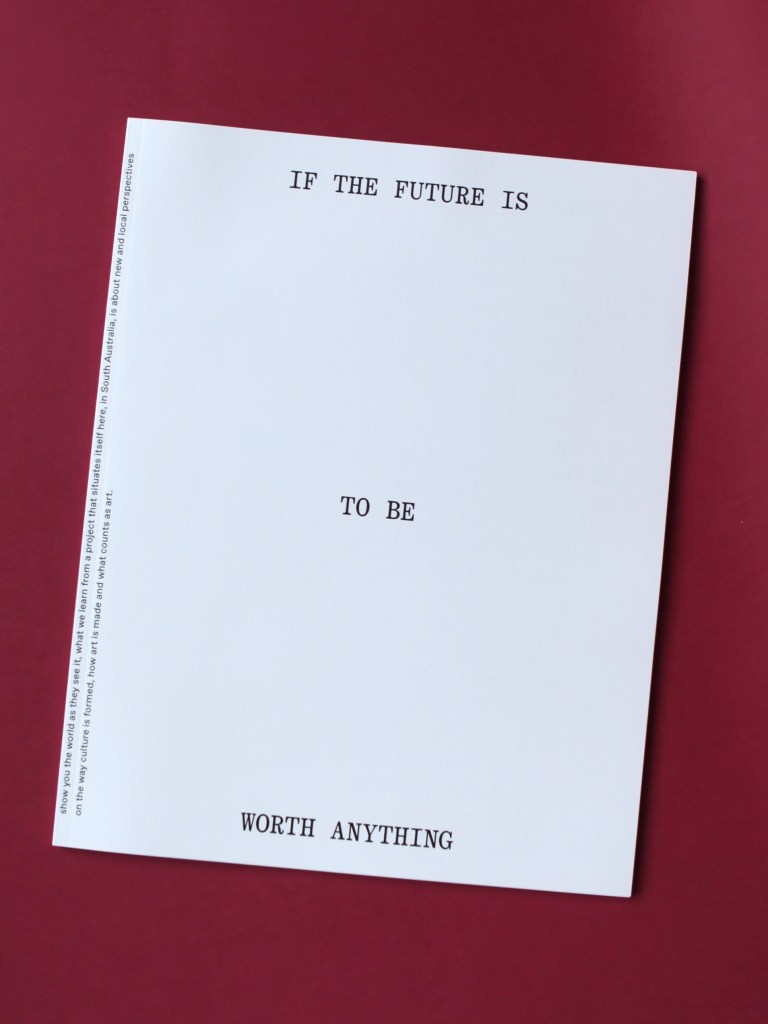
This essay was first published to accompany If the future is to be worth anything: 2020 South Australian artist survey at ACE Open, SA, 12 September – 12 December, 2020.
In 1997 a small choir of singers gathered in the historic halls of Minda in Brighton, South Australia, marking the humble beginning of Tutti Arts. Taking its name from the Italian musical term meaning everyone, Tutti Arts today is a far-reaching arts organisation, spanning music, performing and visual arts, dance, film and radio, for South Australians with learning or intellectual disabilities.
Tutti Arts established its visual arts program in 2006. The program has since become an industrious, highly professional endeavour involving sixty-five artists drawn from across the state. Its focus is neither therapeutic nor didactic. In fact, artists must apply with a portfolio of works; the program is striking in its commitment to the careers of its artists. To visit Tutti Arts studios today is to observe a productive and innovative art centre with artists loyally committed to the daily habits, practices and rituals of creative exploration.
Tutti artist Tessa Crathern best typifies this artistic steadfastness, in person and in practice. Crathern attends the studios four days a week, re-training herself to draw with her left hand after suffering tendonitis; her works on paper reflect a diaristic approach. Her obsession with pattern, line, colour and repetition is methodical, each drawing a daily entry in a larger calendar of works. The recent addition of photographs from Crathern’s own childhood doubles down on the psychological framework of journaling, where subtle shifts in palette can be read as ‘blue days’, ‘green days’ or ‘pink days’.
The passage of time is also a focus for James Kurtze. His latest sculptural assemblage;, a “kooky time travel rocket clock” inspired by childhood memories, describes Kurtze’s recurring nostalgia for the redundant technologies of his youth. His bower-bird-like collection of iPods, outdated iPhones, Nokia flip-phones and VHS paraphernalia reflects Kurtze’s fascination for screen media and the moving image. As an avid filmmaker himself, Kurtze is among one of the founding members of Sit Down Shutup and Watch, a learning disability led festival showcasing films and new media made by artists with learning disabilities, and the first of its kind in Australia.

William Gregory has also made a foray into moving image, having translated his pencil drawings into animation. His latest series depicts orgiastic groupings of women in the style of Botticelli’s Venus. The characters’ playful gestures and Gregory’s cartoonish handling bring folly and frolic to a long tradition of the reclining female nude.
A suite of watercolour and pen and ink works on paper by Ellese McLinden take on play in a far more abstract sense. McLinden’s cartographic treatment of the world around her — suburbia, cityscapes, aeroplanes, domestic gardens — produce dreamlike topographic scenes, playfully surreal in their vibrant colourwashes and soft, fuzzy-edged geometry.
For artist Jackie Saunders, the world around her is underpinned by her connection to Country. Her mother is a Ngarrindjeri woman and her father a Wirangu man; Saunders describes herself as saltwater meets desert. The cobalt blue and bright orange of Saunders’ two large-scale canvases speak to this relationship. Her meditative black brushstrokes twin the surfaces of both paintings, with mark-making that echoes the reverberation of wind across water and sand.
Kurt Bosecke, also working in acrylics, has taken up the subject of prehistoric time. In particular, extinct and exotic birds. The dodo, an Australian masked owl, flamingoes and a cassowary, among others, are brought together in an impossible confluence of birds in his latest large-scale painting, reminiscent of the seventeenth century wunderkammer treatment of still-life painting. The collapsed pictorial and temporal space of Bosecke’s work; its competing horizon lines and multiple perspectives; also describe a kind of horror vacui — fear of empty space. Paint and posca pens compulsively treat every inch of the canvas, even if simply to apply white paint to a white surface.
The diversity of mediums and subjects explored by Tutti artists reflects the program’s artist-led philosophy. On any given day the studios bustle with artists working across painting, printing, digital media, soft sculpture and drawing. Their individual practices reflect this highly contemporary, cross-disciplinary approach; their material innovations arise from its daily structure and stewardship. As the program has matured and expanded over the past fourteen years, it has remained committed to its name. Tutti continues today as a place for artists to gather, to coalesce around the habits and practices of creativity and be supported in the pursuit of their ideas.
Purchase If the future is to be worth anything exhibition catalogue here.
 BELINDA HOWDEN