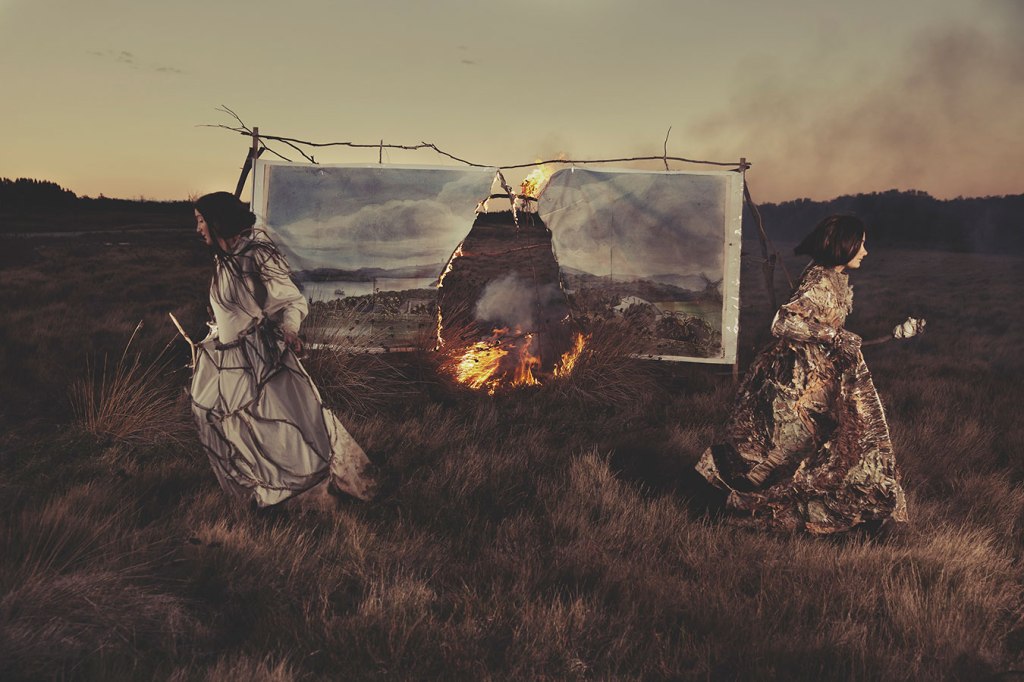
Ash Island and its Transformations
The Lock-Up, Newcastle, NSW
5-28 September, 2014
As it stands today, Ash Island of the Hunter River is not an island. In the 1960s under the Industrial Islands Scheme, a plan devised in response to Newcastle’s expanding heavy industries, the island and its sibling-lands–Goat, Spit, Walsh, Dempsey, Spectacle and Moscheto Islands–were amalgamated to become what is today known as Kooragang.
Despite a dramatic physical transformation, an island presence persists. To visit Kooragang today one must cross a narrow concrete bridge connecting mainland to island, sign-posted ‘Ash Island’. The once prolific Ash tree, resembling the valuable and versatile English Ash, fell victim to the industrious intent of Newcastle’s early colonisation. The scattered few that grow along the southwestern tidal line barely suggest the island’s namesake. To follow the mangrove banks upriver one finds the landscape unceremoniously ends. Here a history of dedication to the island and its unique nature is marked simply by a title: Scotts Point.
Ash Island and its Transformations invites four contemporary artists – Nicola Hensel, Cherie Johnson, Emma van Leest and Shan Turner-Carroll – to examine this persistence. What makes the island historically and culturally significant? And, why does it continue to be important today?
For thousands of years prior to colonisation the Worimi and the Awabakal people made use of the estuary as a meeting point. The region was rich in a variety of birds, frogs, fish, crabs, worms, insects and small mammals, making it excellent grounds for breeding, hunting and fishing. One of the most well documented histories of the Island, however, is that of the Scott family. From 1846 to 1865 Alexander Walker Scott and his family occupied the island. An entomologist and natural scientist, Walker Scott trained his daughters, Harriet and Helena, in the art of natural history illustration and observational drawing. Together they produced a significant body of work on the native moths and butterflies of the island: Australian Lepidoptera and Their Transformations / drawn from the life by Harriet and Helena Scott; and with descriptions, general and systematic, by A. W. Scott. 2014 marks 150 years since the first edition of this publication.
Nicola Hensel’s intensely detailed ink drawings, Ash Island, purposefully mimic the Sisters’ acts of observation and execution. Not only does Hensel position her practice on the island and draw ‘from the life’, she recreates the intensely private yet dynamic geometry between the eye, the pen, the subject, the paper surface and ultimately the viewer. Similarly, Emma van Leest engages the space between maker, observer and site by simulating a walk through the island’s mangroves. Each cutting of Between the Shadows and Forgetting (2014) echoes a layer of history trapped beneath the mud. Van Leest makes use of the redemptive site, a tidal zone for filtration and cleansing, to bring to light sunken memories of occupation and human imprint.
Shan Turner-Carroll and Cherie Johnson broaden the subject by presenting alternative histories. Turner-Carroll’s photographic series, Hattie and Nellie (2014), postulates about the inner lives of the girls. He speculates on their development as young women growing up in the early colony of Newcastle, their sense of duty to the site and the broader scientific community, the intimacy of their relationship with the island and their belief, for better or worse, in the importance of their role as natural history illustrators within a developing nation.
Johnson, however, looks to a history beyond the Scotts. The dillybag, fishtrap-like sculptures of Within (2014) counterbalance a colonial attitude of possession and occupation. Through her scavenged electrical materials Johnson acts as a cultural conduit, weaving an alternative story of two women connected to the island. Aunty Glenda Simon and Aunty Sandra Griffen recount their childhood memories of growing up upon the island, their oral histories shifting the focus from ownership and displacement to custodianship and connection to country.
Today the Hunter Estuary is being regenerated through the work of the Kooragang Wetland Rehabilitation Centre and its body of dedicated volunteers. In an ironic turn, the centre makes use of the many documents produced by the Scott Family to inform the process of regeneration. As Kooragang is transformed again, Ash Island’s status as an island remains remarkably untouched. It mercurially shifts with changes in ecology, use and occupation, reinforcing its presence as a unique and resilient site.
Ash Island and its Transformations was supported by the NSW Government through Arts NSW.
 BELINDA HOWDEN